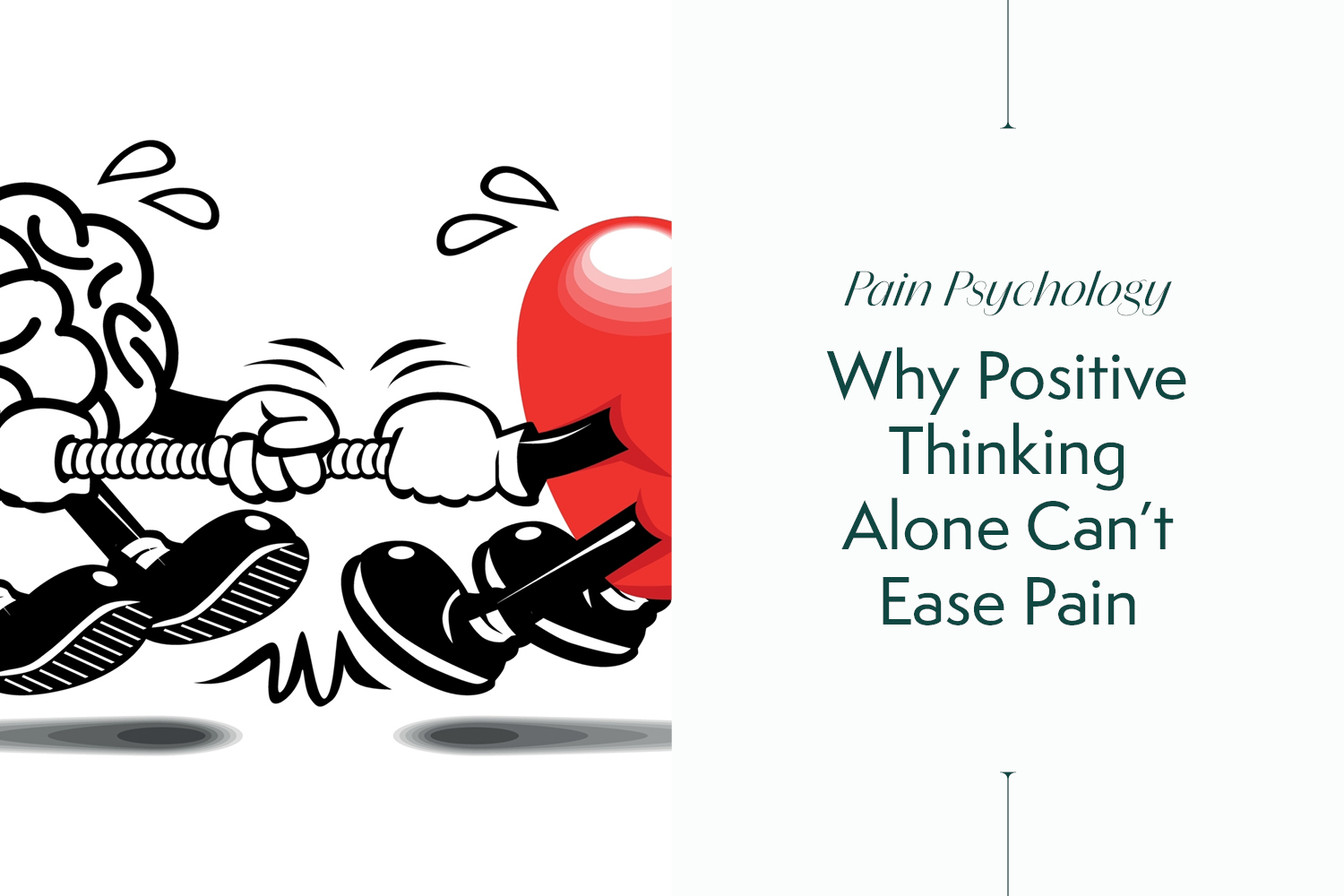
If you live with chronic pain, you’ve likely been told to “stay positive” or “focus on the good.” It’s well-meaning advice, but it often falls flat, leaving you feeling frustrated and misunderstood.
Why doesn’t it work?
Because your body has a mind of its own.
Pain is not just a thought you can wish away. It’s a deeply ingrained physical experience. And to change it, you have to speak your body’s language.
You can repeat the phrase “I am relaxed and at ease” a thousand times, but it won’t convince a body that’s physically locked in a state of high alert.
If your heart is racing, your muscles are clenched, and your system is flooded with stress hormones, your body’s reality will always shout louder than your thoughts.
Think of it like trying to convince a shivering person that they’re warm. Words don’t work. They need a blanket. Your body is the same.
It needs a real, physiological signal that it’s safe before it will believe any cognitive suggestion you give it. Without that buy-in, positive thinking is just noise.
That persistent tightness in your shoulders isn’t just a random muscle spasm. It might be the physical residue of years spent at a stressful job.
The tension in your hips could be the stored memory of an old injury or a difficult emotional event.
Your conscious mind may have moved on, but your body remembers. It holds onto past experiences as protective patterns. This isn’t a flaw; it’s a survival mechanism.
Your body doesn’t care if you’ve mentally processed an event. If it learns to brace for impact, it will keep bracing until it physically learns how to stop.
Your nervous system is ancient and primal. It existed long before abstract language. It doesn’t understand motivational quotes or positive affirmations. It understands sensation.
A warm bath. The feeling of grass under your feet. A deep, slow breath. A gentle, reassuring touch. These are the things that tell your nervous system it’s safe.
Sensation is the language of the body. It’s the only input that can effectively override the persistent alarm signals of pain and stress.
You can’t force a muscle to relax, and you can’t command your nervous system to be calm. True, lasting change only happens when your body receives the message that it is genuinely safe.
When your nervous system shifts out of its protective “fight or flight” mode, everything changes. Your breathing deepens, your muscles can finally let go, and your body can divert its energy from defence to healing and repair.
This state of “felt safety” isn’t an intellectual concept. It’s a physical state you must experience to understand.
So how do you give your body that feeling of safety?
This is where chiropractic care can be a powerful tool. A gentle, specific adjustment is a direct and profound sensory input. It’s a physical conversation that tells your nervous system, “The danger has passed. You can stand down now.”
It interrupts the vicious feedback loop where pain creates tension, and tension creates more pain. Each adjustment acts as a practice session, giving your body a tangible experience of ease.
Over time, this helps to rewire the old patterns, teaching your body that safety and comfort are possible again.